
IRA income is often tax-deferred until distribution, or may receive tax-free distributions in a Roth IRA, if applicable requirements are met. But certain investment structures can create taxable income inside the account, which is where self-directed IRA UBIT and UDFI may apply.
This usually becomes relevant when an IRA invests in an operating business, receives partnership income, or uses leverage to acquire real estate. UBIT and UDFI generally apply only to certain income types and investment structures, not every alternative investment.
What Is UBIT and Why Does It Exist?
UBIT stands for Unrelated Business Income Tax. More specifically, UBTI refers to the unrelated business taxable income allocated to or generated inside the IRA, while UBIT is the tax applied to that income. The terms are often used interchangeably, but the general rule is that an IRA may owe tax when it receives income from an active trade or business that is unrelated to the IRA’s tax-advantaged purpose.
These rules were generally intended to limit tax-advantaged entities from sheltering active business income that would otherwise be taxable. Since IRAs receive tax advantages under federal law, similar tax principles may apply when retirement account assets receive income from business operations rather than passive investment activity.
That distinction matters. Certain passive investment income is generally excluded from UBTI. Active business income may be treated differently.
Just as important, unrelated business income tax IRA rules do not mean all alternative assets are taxable. UBIT is not a blanket tax on self-directed investing. It applies only when the nature of the income crosses into specific UBTI or UDFI categories.
Income Types Generally Excluded From UBIT
Many common self-directed IRA income types may be excluded from UBTI, depending on the facts and structure of the investment. This may include rental income from debt-free real estate, interest earned from private notes, dividends, capital gains, precious metals holdings, and tax lien investments.
In other words, the presence of an alternative asset alone does not automatically create UBIT exposure. The potential taxable issue is usually tied to business activity, debt-financed income, or other income categories treated as taxable under UBIT rules, not simply owning something outside the public markets.
What Triggers UBIT in a Self-Directed IRA?
Common self-directed IRA UBIT situations involve an IRA receiving income from an active business rather than passive investment income. This may happen when retirement account assets are invested through pass-through entities such as LLCs or partnerships.
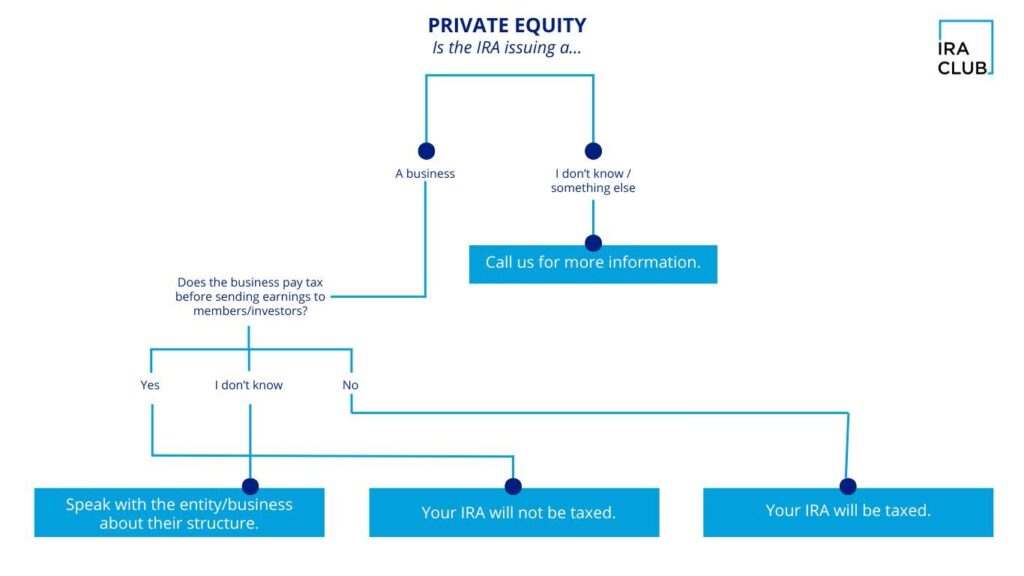
For example, an IRA may purchase an ownership interest in a startup, a manufacturing company, a restaurant group, or another operating business. If that entity generates ordinary business income and passes it through on a Schedule K-1, the IRA’s share may be treated as unrelated business taxable income, or UBTI, which may be subject to UBIT.
Private equity and partnership investments may create similar UBIT considerations. The important point is that the legal structure and income classification matter more than the investment label itself.
Common Self-Directed IRA Income Types That May Not Trigger UBIT
Alternative assets do not automatically create UBIT or other current tax obligations inside a self-directed IRA.
Directly owned, debt-free rental property generally does not create UBTI from rental income alone. Private lending income is typically treated as passive interest income. Precious metals and tax liens also generally do not create UBTI by themselves, depending on the facts and structure of the investment.
The income source and financing structure matter. UBIT concerns are generally tied to active business income, debt-financed income, or other taxable income categories, not simply holding alternative assets.
How UDFI Differs From UBIT in a Self-Directed IRA
UDFI stands for Unrelated Debt-Financed Income. It is not a separate tax system, but rather a subset of the broader UBIT framework. While UBIT often comes from active business income, UDFI may arise when borrowed money is used to generate income allocated to an IRA.
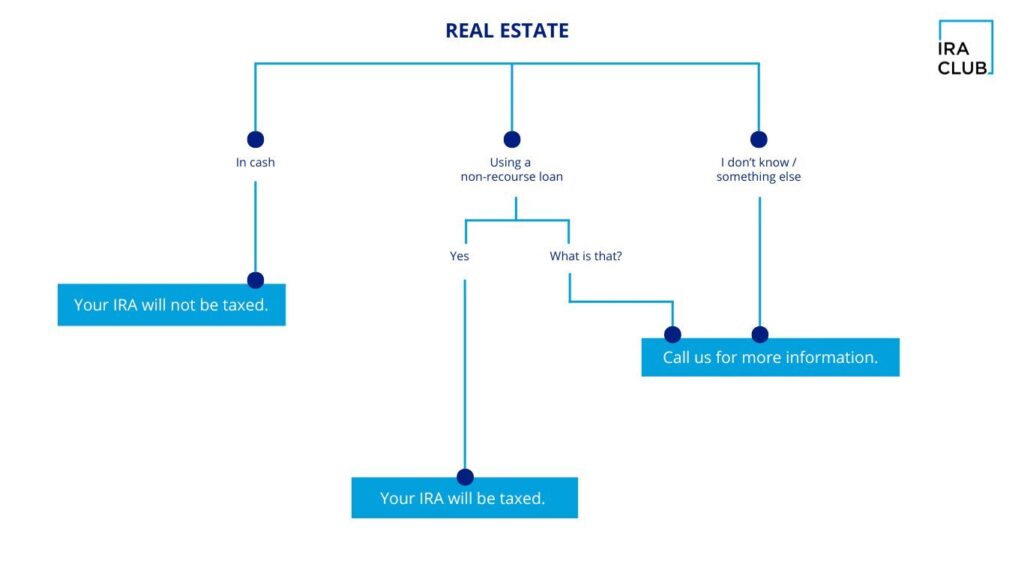
A common example is leveraged real estate. If a self-directed IRA purchases a property using a non-recourse loan, the financed portion of the income and gains may become taxable under unrelated debt-financed income rules.
In general, UBIT is often tied to active business income, while UDFI is tied to income from debt-financed property.
Leveraged Real Estate UDFI Example
Assume an IRA purchases a rental property for $200,000. The account contributes $100,000 in cash and uses a $100,000 non-recourse loan to complete the purchase. Because half of the acquisition was debt-financed, approximately 50% of the income and eventual gain attributable to that financed portion may be subject to UDFI, subject to the applicable UDFI calculation rules.
This is one reason a non-recourse loan structure is often reviewed before an IRA-owned property purchase closes. It is also important to know that this rule can apply in a Roth IRA as well. Roth status does not automatically eliminate account-level tax during the investment phase.
How UBIT Is Generally Calculated and Reported
If an IRA generates $1,000 or more in gross income from an unrelated trade or business, Form 990-T is generally required. The filing is made for the IRA at the account level, not on the IRA owner’s personal tax return.
The account may be eligible for a $1,000 specific deduction, and allowable expenses such as depreciation or other related deductions may reduce the final taxable amount. The IRA itself pays any UBIT due directly from available account cash.
Depending on the reporting setup, the IRA may also require a separate employer identification number, or EIN, for filing purposes. The key administrative point is that taxable income inside the IRA does not mean the IRA owner personally pays the tax from personal funds; the retirement account generally pays the tax from IRA assets.
How UBIT Reporting Is Generally Handled in a Self-Directed IRA
If UBTI or UDFI is generated, there is generally an administrative sequence that follows.
First, the IRA receives K-1s or other tax reporting documents from the investment sponsor or entity. Next, the IRA owner may work with a qualified tax professional to determine whether Form 990-T is required.
That last point matters for account administration. If the account may generate taxable income, available IRA cash may be needed to cover filing costs and tax payments.
UBIT Exposure Considerations
The purpose is not to avoid every investment that may generate tax. The purpose is to understand potential account-level tax costs before IRA funds are directed to an investment.
Where practical, leverage levels may be reviewed for potential UDFI exposure, especially when analyzing leveraged real estate tax treatment. For partnership or private placement investments, offering documents are commonly reviewed to determine whether ordinary business income may be passed through on a K-1.
After-tax analysis may also be part of the review. An investment may look different after accounting for UBIT, filing requirements, and liquidity needs. For self-directed IRA investments, tax impact is generally evaluated alongside projected income, expenses, and account-level reporting requirements.
When to Consult a Tax Professional
Certain investments may require a qualified tax professional review before IRA funds are directed to an issuer. Examples include any deal involving leverage, any investment expected to issue a Schedule K-1, any ownership interest in an operating business, and any income source that appears active rather than passive.
These questions are generally easier to evaluate before the IRA acquires the asset than after taxable income is reported.
Frequently Asked Questions
What is UBIT, and can it apply to self-directed IRAs?
UBIT stands for Unrelated Business Income Tax, a tax that can apply when a self-directed IRA receives income from an active trade or business rather than passive investment income. This may arise when the IRA owns part of an operating company, receives pass-through business income, or holds certain private equity investments. The key point is that not every self-directed IRA asset creates UBIT exposure; the income type and investment structure matter.
What is the difference between UBIT and UDFI?
UBIT is the broader tax that may apply when a tax-advantaged account has taxable unrelated income. UDFI, or Unrelated Debt-Financed Income, is a type of income that may be subject to UBIT when debt is used to generate income allocated to the IRA. UDFI, or commonly through leveraged real estate. In general terms, UBIT is often tied to active business income, while UDFI is tied to income from debt-financed property.
Can a Roth IRA Owe UBIT or UDFI?
Yes. A Roth IRA may owe UBIT if the investment structure creates UBTI or UDFI inside the account. For example, if a Roth IRA buys a $200,000 property using $100,000 cash and a $100,000 non-recourse loan, a portion of the income and gain attributable to the debt-financed amount may be subject to UDFI, based on applicable calculation rules.
What investments may trigger UBIT inside an IRA?
Common triggers may include LLC or partnership interests in operating businesses, private equity deals that issue Schedule K-1 business income, and leveraged assets that generate debt-financed income. Debt-free rental real estate, private lending, precious metals, and tax liens generally do not create this issue on their own, depending on the facts and structure of the investment.
How is UBIT reported and paid by an IRA?
If the IRA generates $1,000 or more in gross income from an unrelated trade or business, Form 990-T is generally required. The IRA itself generally pays any UBIT due from available IRA funds, after applicable deductions, including the $1,000 specific deduction, are applied. This process may involve coordination among the IRA owner, a qualified tax professional, and the qualified IRA custodian.
UBIT and UDFI as Account-Level Tax Considerations
UBIT and UDFI are not automatic reasons to avoid alternative assets; they are account-level tax considerations that may require review before IRA funds are directed to an investment. When leverage, partnership income, or business activity may create account-level tax or reporting considerations, the income type, ownership structure, and reporting requirements should generally be evaluated in advance.