UBIT & UBTI: Taxes on Your Self-Directed IRA Investments
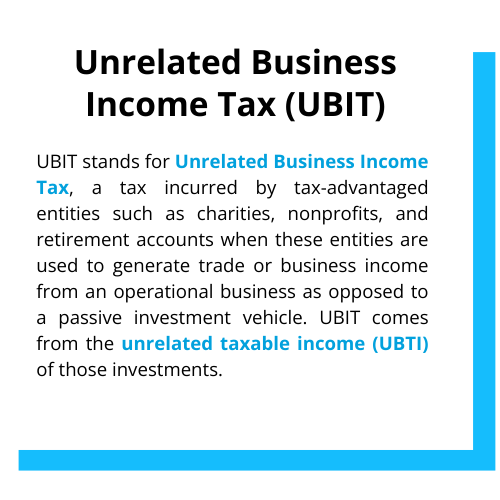
When a Self-Directed IRA earns income from an active business, including certain short-term rental or Airbnb-style activities, or uses a non-recourse loan to acquire real estate, it may generate unrelated business taxable income (UBTI). UBIT is the tax that may apply to that income.
UBTI is the income subject to analysis, while UBIT is the tax that may apply. Unrelated debt-financed income (UDFI) is income attributable to debt-financed property, such as real estate acquired with a non-recourse loan, that may be included in UBTI.

What is UBIT and UDFI?


How Does UDFI Work?
Here's An Example
Assume a Self-Directed IRA acquires a $100,000 real estate investment using $50,000 of IRA funds and a $50,000 non-recourse loan.
If the property generates $10,000 of net income, the debt-financed portion may be treated as UDFI and included in UBTI. In this simplified example, 50% of the property is debt-financed, so $5,000 may be included in UBTI before applicable deductions and adjustments. UBIT may apply to the resulting UBTI.
How Is UBIT Calculated?
Calculating UBIT involves determining an IRA’s unrelated business taxable income after applicable deductions and adjustments. The calculation may depend on the type of income, related expenses, debt-financed property, and other tax rules. We recommend consulting with a knowledgeable CPA who understands both IRAs and unrelated business taxable income to ensure your IRA is paying the correct amount of UBIT.
For federal tax purposes, an IRA is generally treated as a trust. UBIT may be calculated using applicable trust tax rates and reported on Form 990-T when required.
Trust Tax Brackets for 2026
For UBIT reported by a trust taxable at trust rates, the following brackets apply for tax years beginning in 2026:
| Taxable Income Range | Tax Rate |
|---|---|
| $0–$3,300 | 10% |
| $3,301–$11,700 | $330 + 24% |
| $2,346 + 35% | $16,001 and over |
| $16,001 and over | $3,851 + 37% |
Calculating UBIT
A simplified UBIT calculation begins with gross income from an unrelated trade or business. Applicable deductions, adjustments, and other allowable items are then used to determine taxable UBTI.
UBIT = Taxable UBTI × Applicable Trust Tax Rate
This formula is simplified. UBIT calculations for a Self-Directed IRA may also depend on the type of income, related expenses, debt-financed property, and other applicable tax rules. Consult with a CPA or experienced tax professional.
Will My Investment Trigger UBIT?
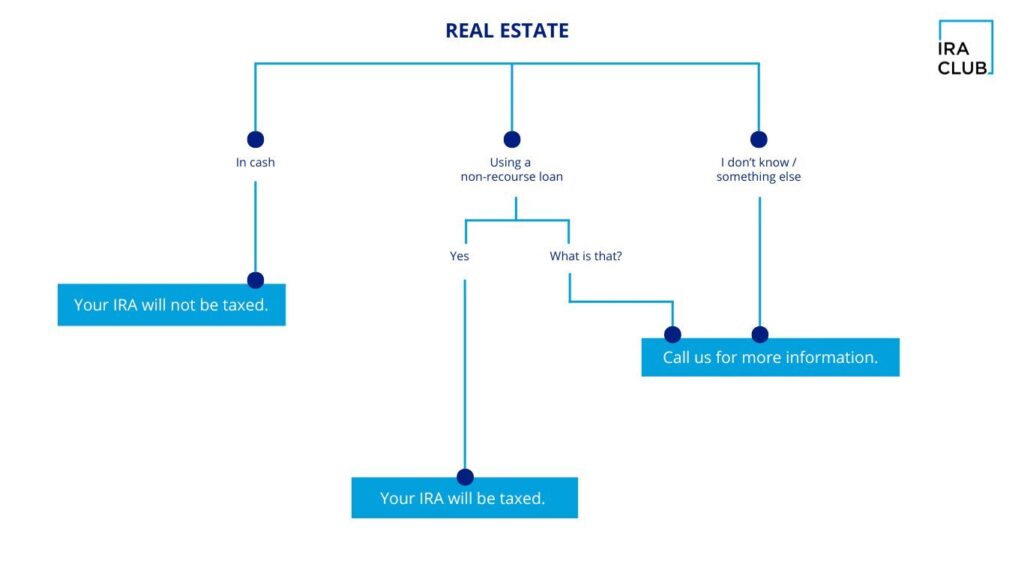
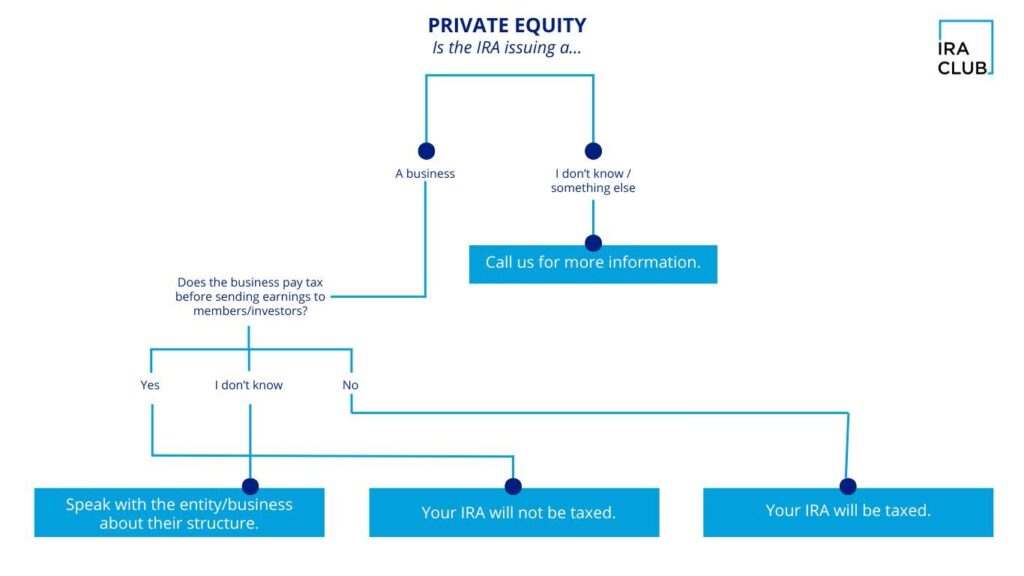
Certain IRA investment activities may generate unrelated business taxable income (UBTI), including active businesses such as restaurants and convenience stores, cryptocurrency mining operations, and frequent real estate transactions that may be treated as a trade or business. Airbnb-style short-term rentals may also require UBTI analysis depending on the rental activity, services provided, and other facts. UBIT may apply to taxable UBTI.
Click any button below to find out if your investment might trigger UBIT.
Solutions to the UBIT “Problem”
Whether UBIT may apply, including through UDFI, depends on the investment’s income, financing, ownership structure, and other applicable tax rules. The following factors may affect the analysis:
- C corporation investments: Dividends from C corporation stock are generally excluded from UBTI, although the corporation may be subject to corporate income tax, and other rules may apply.
- Debt-financed property: Income attributable to debt-financed property may be treated as UDFI and included in UBTI.
- Solo 401(k) plans: Certain qualified plans, including some Solo 401(k) arrangements, may qualify for an exception from UDFI on debt-financed real estate. This exception does not apply to all forms of UBTI.
Our team can help you understand how UBIT and UDFI may apply to your self-directed IRA, and what strategies may be available to you.

Ready to talk through your investment situation?
Our team can help you understand how UBIT and UDFI may apply to your self-directed IRA, and what strategies may be available to you.

How Do I File For UBIT?
An IRA with $1,000 or more of gross income from an unrelated trade or business or debt-financed property may be required to file IRS Form 990-T. The form reports unrelated business taxable income (UBTI) and calculates any unrelated business income tax (UBIT).
The IRA’s EIN is generally required for the filing. Form 990-T is generally due by the 15th day of the fourth month after the end of the tax year. For a calendar-year IRA, the due date is generally April 15.
We recommend speaking with an experienced CPA or tax professional to determine the exact UBIT amount & to file IRS Form 990-T.
IRS Form 990-T is due April 15th.
Have Questions?
FAQS
UBIT is paid from the IRA’s funds, not the account holder’s personal funds. UDFI is not a separate tax. It is income from debt-financed property that may be included in UBTI, which may be subject to UBIT.
Possible sources of IRA cash, subject to applicable rules, may include an eligible transfer or rollover, an allowable IRA contribution, or liquidation of IRA assets. A personal payment toward the IRA’s UBIT liability may be treated as an IRA contribution and is subject to applicable contribution limits and eligibility requirements.
For 2026, the IRA contribution limit is $7,500, with an additional $1,100 catch-up contribution for individuals age 50 or older.
Certain categories of income are generally excluded when calculating UBTI, including dividends, interest, royalties, certain rental income, gains or losses from the disposition of property, and certain research income. These exclusions may not apply in all circumstances, including where income arises from debt-financed property or rental activities involving services.
Limited partnerships and limited liability companies may generate UBTI when they conduct an active trade or business. Debt-financed investments, including property acquired with a non-recourse loan, may also generate UDFI that is included in UBTI. An investment’s entity type alone does not determine whether UBIT applies.
Unrelated business taxable income (UBTI) is income from an unrelated trade or business that may be taxable to an IRA. Unrelated business income tax (UBIT) is the tax that may apply to taxable UBTI.
UBTI refers to the income. UBIT refers to the tax.
Passive rental income from real estate held by an IRA is generally excluded from UBTI. However, if the IRA uses a non-recourse loan to acquire the property, income attributable to the debt-financed portion may be treated as UDFI and included in UBTI. UBIT may apply to the resulting taxable UBTI.
Rental activity treated as an active trade or business, including certain frequent property sales or short-term rental activities with substantial services, may also generate UBTI. Tax treatment depends on the facts and circumstances. Consult a CPA familiar with self-directed IRAs to assess your specific situation.
UBIT is generally calculated by determining gross income from an unrelated trade or business or debt-financed property, then applying allowable deductions and adjustments to determine taxable UBTI. The applicable trust tax rate is then applied to taxable UBTI.
UBIT = Taxable UBTI × Applicable Trust Tax Rate
This is a simplified formula. The calculation may also depend on the IRA’s investment structure, related expenses, debt-financed property, and other applicable tax rules. We strongly recommend working with a CPA who understands both IRAs and UBTI to ensure your account pays the correct amount.
Certain qualified plans, like Solo 401(k) plans, may qualify for an exception from UDFI on debt-financed real estate. When the exception applies, qualifying debt-financed real estate income may not be included in UBTI. The exception does not apply to all forms of UBTI, and its availability depends on applicable plan and transaction requirements.
An IRA with $1,000 or more of gross income from an unrelated trade or business or debt-financed property may be required to file IRS Form 990-T. The form reports unrelated business taxable income (UBTI) and calculates any unrelated business income tax (UBIT) liability.
An IRA filing Form 990-T generally requires its own employer identification number (EIN). For a calendar-year IRA, Form 990-T is generally due April 15. Because Form 990-T is filed by the IRA rather than the account holder personally, a qualified tax professional may assist with the filing and related tax calculations.
Generally, no. UDFI applies only to income attributable to debt-financed property. If an IRA acquires real estate entirely with cash and no borrowed funds are used, the property’s income is generally not treated as UDFI.
However, the income may still require UBTI analysis if the real estate activity is treated as an unrelated trade or business, such as certain short-term rental activities involving substantial services.